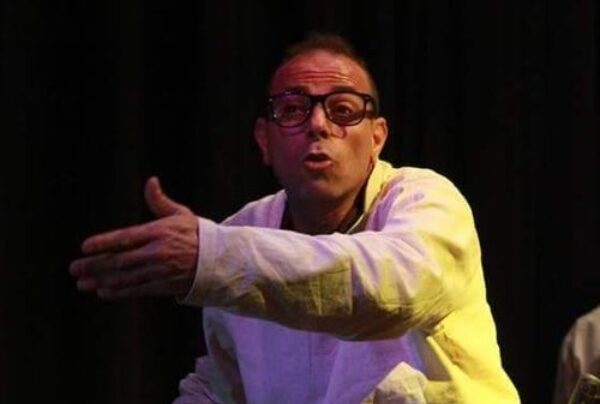
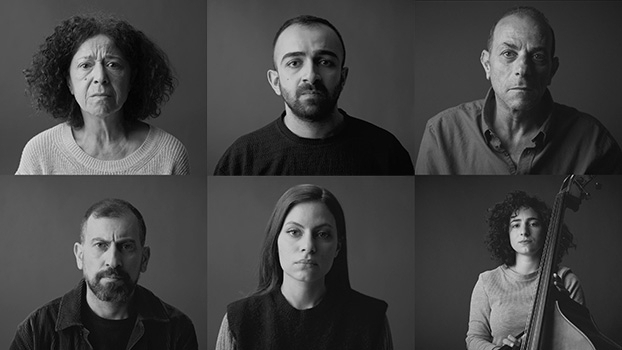
Al Madhoun was born and raised in Gaza, where he founded “Theatre for Everybody” together with Jamal Al-Razi and Marianne Bloom and worked with traumatized children and youth through drama therapy as well as a child protection specialist at a national organization. After October 7, on 12th April 2024, he left Gaza with his family and now lives in Cairo, where he continues his cultural activism. In a new film project, “Gaza: Eyewitnesses“, he and five other Palestinian artists bring the realities of daily life under death threat to the forefront.
Hossam, if you had to describe the film project in a few sentences, how would you do it?
As a Palestinian, before being an actor or writer, I see the film project as a platform to share my story and reach people, since there are very limited public platforms for Palestinian narratives. That’s the most important thing.
Not only are you Palestinian, but you are also from Gaza. Could you share your personal story about the war in Gaza?
On October 7, I woke up at four or five in the morning to the sound of a huge crowd in the building. I went outside and heard about the Hamas attack on Israel. I always avoid watching violent images. I follow the news by listening, not watching. Seeing violence is not pleasant for me. I knew that this was a turning point. I knew the retaliation would be unlike the wars in 2009, 2008, 2014, 2021 and 2023. There was real panic. In three days, the Israelis forced or disseminated an order for people in northern Gaza to evacuate their homes and go to the middle of the strip. For our safety, my wife and I decided to leave. Our daughter was in Lebanon; she had left home for the first time to pursue her master’s degree in human rights. We left on the 12th. We went to the middle area. Then, in November, we moved to Rafah, and in April, we went to Egypt. Since then, we have been in Cairo.
In the film project, you present your own texts. Did you write the texts specifically for the film, or did you write them during the war?
I write during war. I don’t write much, but during wars, I write almost every day. In every war that has been waged on Gaza, I have written. You know, during such times, you feel completely alone, especially since you’re not in the media. There are no condemnations for the killing of civilians, and only a few friends abroad call me to check on me and my family. Mainly my friend, [theatre director] Jonathan Chadwick. He was always the first to call and check on me. When he called, I got emotional and couldn’t talk. So, I found myself writing down how I felt, what I went through, and what I observed. I wrote it in English and shared it with him. I did this in every war, and there were about 20 to 30 reports. During this genocide, I wrote almost every day. I wrote more than 160 diary entries and testimonies about my life during the genocide. I mainly wrote them to share with Jonathan. However, because the war contained references to many other countries, people from those countries started contacting me. I started sharing them with more and more people, including French, British, American, Belgian, Norwegian, and Swedish friends. The stories in the film are just a part of what I wrote during the war.
Could you share one of the stories you present in the film with us?
One story is about sounds. Usually, you don’t pay much attention to the small sounds around you, only to the sounds that grab your attention, are loud, or that you’re trying to hear. But in war, your senses become very alert because sounds could mean life or death at a certain point. Because of the shooting, shelling, bombardment, and explosions. At night, when there was no electricity because it had been cut completely, my bedridden mother was unable to sleep because of her anxiety about the war. I was concerned and worried about my family. A big part of my family remained in Gaza City. They didn’t leave. At night, I focused on the sounds. Since it was quiet, I could hear many other sounds rather than those related to the war. For example, I heard the sound of leaves and branches moving in the breeze, a child crying, a baby and his mother, and birds going back to their nests. All of these sounds relaxed me because they meant life to me. But this war brought sounds of death. Then, the sound of a rocket, shelling, bombing, or shooting would come and break and erase all of these living sounds. It was an experience you wouldn’t have on normal days when there’s no war. If you’re camping in nature, you might be surprised by the sounds of a stream, a cow from a distance, a bird, or the rustling of leaves — sounds you don’t normally hear in the city.
The film was developed by Palestinian artists from different regions. What was this experience like for you?
It was amazing. Amazing on many levels. First, because we are under occupation, which prevents us from being in touch with each other. I can’t reach Ramallah, Haifa, or Jerusalem. They can’t reach Gaza, and we can’t reach them. As artists, we only know each other through the media. We read about each other and see each other’s work on TV or social media. However, we never meet or work together. It was like a dream come true. It was valuable for me to experience how these artists think and perceive art. There were many testimonies which could not be presented in one film, My self and Salwa Naqara worked over the testimonies and chose the final version of what to present in the film, I also worked on the actors’ accents to make them more typical of Gaza. It was a rich, intellectual, and creative process. I loved it and enjoyed every minute.
Most of the work for the film and preparation for filming was done over Zoom, but filming itself took place in Berlin. Unfortunately, you were the only one who could not join us because you did not receive a Schengen visa. How did that affect your participation in the project?
Did that affect my participation in the project? Because we did it eventually. The cameraman, Aleko [Gotscheff], and another artist who participated in the film, Ahmad Tobasi, came to Egypt, and we filmed my scenes here. But it hurt me personally. I’m an artist. I’ve traveled to Europe and America many times, as well as many other countries. I’ve always been a law-abiding citizen wherever I was, and I expected to be treated with more respect as a human being, as a Palestinian, and as an artist. I felt like we were rejected. We are not treated equally as human beings. That was really unfair, unjust and unpleasant.
Let’s move on to the testimonies. They are heavy. They are sad. They are overwhelming. Partially. But the film also has humorous episodes. For example, there is a party held in appreciation of the donkeys for being people’s best friends and supporters during the war in Gaza, since there is no fuel to use in vehicles. Why was it important for you and the other team members to include humor in this film?
Do you think the two million people still in Gaza are crying and weeping 24/7? Despite everything, they are still living and practicing everyday life. They laugh and make jokes about how they seek water to drink or wait in lines for food. They chat. They speak. They live. They make fun of their catastrophes and pain to overcome them and continue living. They do this in many different ways. The donkey appreciation party was real and organized by my friend, theater and TV director Mustafa Nabih. There was a festival and a red carpet. He organized it to show that we are living human beings.
Every artist I know in Gaza, whether they are painters, musicians, dancers, clowns, theater makers, or writers, practices their art – mainly with children and women. They never stopped. They get married and have babies. They continue living. Unfortunately, they have very negative coping mechanisms, including living in tents rather than in their homes, walking long distances to collect water rather than turning on a tap, eating one meal rather than three per day, standing in queues for hours to receive aid rather than being at work, and overcoming fear rather than sleeping in peace. But they are alive. So they continue living. They make love and jokes about what they go through as a way to be resilient. Otherwise, they will collapse. Otherwise, it will all be in vain. They’re just human.
The film is currently being screened in various locations in Germany and Great Britain, and will soon be shown in other places around the world. You can often join the post-film talk on Zoom. How has the film been received so far?
It was very well received. People found it very emotional. Most of the reactions I received during the post-screening discussion showed sympathy, support, and understanding. At the screening in London, one woman mentioned what happened to the Jews during the Holocaust. Which was awful, it was a crime against humanity, and no one can deny or accept it on any level. I told her that, Nazi propaganda dehumanized Jews at that time, making it easy for German soldiers and their collaborators to kill innocent people because they didn’t see them as human. Unfortunately, today it is similar in the sense that most Israelis dehumanize the Palestinians. They claim there are no innocents in Gaza. They say that they are not human. This made it easy for Israeli soldiers to bomb and kill in Gaza. Although most people in Gaza are innocent civilians, including children and women. Two-thirds of the population are children and women, and one-third are men. So they know that more than 70% of those killed were innocent people. The lady burst into tears. She said, “Yes, it should stop.”
This film is not easy to watch, even for outsiders. At least, for the average audience. But how is it for you, someone from Gaza, to watch it and discuss it repeatedly?
I can tell you it’s not easy. To be frank, when I come to a screening, I don’t watch the film. I can’t. Seeing or hearing about these disturbances brings me back to reliving them over and over again. It eats me up inside. I avoid violent images, and I avoid listening to these details as much as I can because they generate the same feelings I had when I experienced it. However, the experience is still inside me, so I can respond after the screening. This film is not for Palestinians from Gaza because they are already living it. I’m sure they’ll think it’s superficial because we filmed it just before the period of starvation, which was much worse than we show in the film. It is a message for outsiders, not for the people of Gaza.
What is the most important experience or lesson you took away from this project?
To find as many platforms as possible to share our stories as Palestinians. Not only daily testimonies, but the whole Palestinian story. We need to stop perpetuating the idea of a Palestinian-Israeli conflict. There is no conflict whatsoever. There is a colonial occupation of land and people. This occupation should end. That’s it. The occupying power must meet its obligations under international human rights and humanitarian law, respect the Geneva Conventions, and end the occupation. This is not a conflict. As I said in the beginning, this is a platform where we can share part of our narrative, and I am encouraged to share as much as possible. I did several things afterward. I was in London and Cambridge, where I presented my story as a theater maker. This is not separate from my identity as a Palestinian under occupation. Some of my diaries have been adapted into a theater show in Belgium. My diaries have also been printed in two French editions in Belgium. A group of artists in Italy reads my diaries in front of audiences. They have also been read in London under the title Hossam’s People. This is what I’m trying to do. I’m currently working on another project with a French director. I’m also planning to participate in a theater production with Belgian artists with whom I worked many years ago. They are coming to Egypt, and we are going to create a play and tour Belgium, France, and Luxembourg again, as we used to do. I also wrote three theatre plays, one about the children under genocide, one about the prisoners and how their life impacted by the torture and inhuman treatment they went through and one about the famine.
The situation in Gaza remains very difficult. What do you wish for Gaza and its people?
Describing the situation in Gaza as difficult or rough is meaningless. It doesn’t express what’s happening there. I mean, the genocide continues and did not stop for a moment after the ceasefire. This agreement was not a ceasefire but rather permission for the Israelis to continue the genocide. Silence. Since the so-called ceasefire in October 2025, they have killed over 1,000 people, including at least 350 children. They never committed to any of the agreements regarding food. They agreed to allow 600 truckloads of goods and medicine for the people but never allow more than 200 to 250 per day. We discuss the details of allowing certain kinds of medicine because they are urgent, yet thousands of other medicines are still not permitted. We are discussing ways to pressure Israel into allowing us to import engine oil to keep the standby generators in hospitals operating. Ministers and foreign ministries of various countries are asking the Israelis to please allow us to bring in engine oil to keep the standby generators operating. Is this logical? We should discuss a complete withdrawal from Gaza, rebuilding the area, freeing the people, and establishing a Palestinian state. People are still enduring agony and hardship in poor tents with no sanitation, hygiene materials, adequate water, or food. Every day, they are taking more and more of Gaza. Since October 7th, They controlled 46% of Gaza. Now it is more than 60%. They move the so-called “yellow line” every day. It’s a large block of stones painted yellow, and they move it further inside. With every movement, a few hundred more people and families are displaced, and there is no adequate shelter for them to establish a new life. Words are inadequate to describe what people are going through.
Is there anything else you would like to tell the readers of this interview?
Europe’s greatest legacy, especially in the last century, is the foundation of a system that protects civilians and innocent people everywhere and at all times. This includes the system of human rights, international human rights law, international humanitarian law, the Convention on the Rights of the Child, and the Fourth Geneva Convention. Europe should be proud of this great legacy. Unfortunately, however, this legacy is being completely destroyed by the Israelis’ targeting of civilians in Gaza and the West Bank. Europe has a responsibility to protect this legacy. Allowing genocide to occur anywhere, not only in Gaza, leaves a scar on the face of humanity. If it happens in Gaza today, it will happen everywhere tomorrow. without any reaction. And this is a loss and a failure for human rights, not for Palestinians. What’s happening in Palestine is not any more a Palestinian issue. It’s a human issue. It’s the human race who is responsible to put an end to that.
***
The interview was held on June 21, 2026.