Israeli society has not known calm since the 2023 judicial reforms. The Hamas attacks on 7 October, the hostage crisis, the criminal war in Gaza and the wars in Lebanon and against Iran have all increased the speed of the Israeli state’s authoritarian transformation.
Polls show that winning a majority is out of reach for the governing parties. Against this backdrop, there are increasing signs that the government is attempting to interfere in the election process. Back in July, Israel’s president Isaac Herzog warned that free elections are in danger.
Free Elections in Danger?
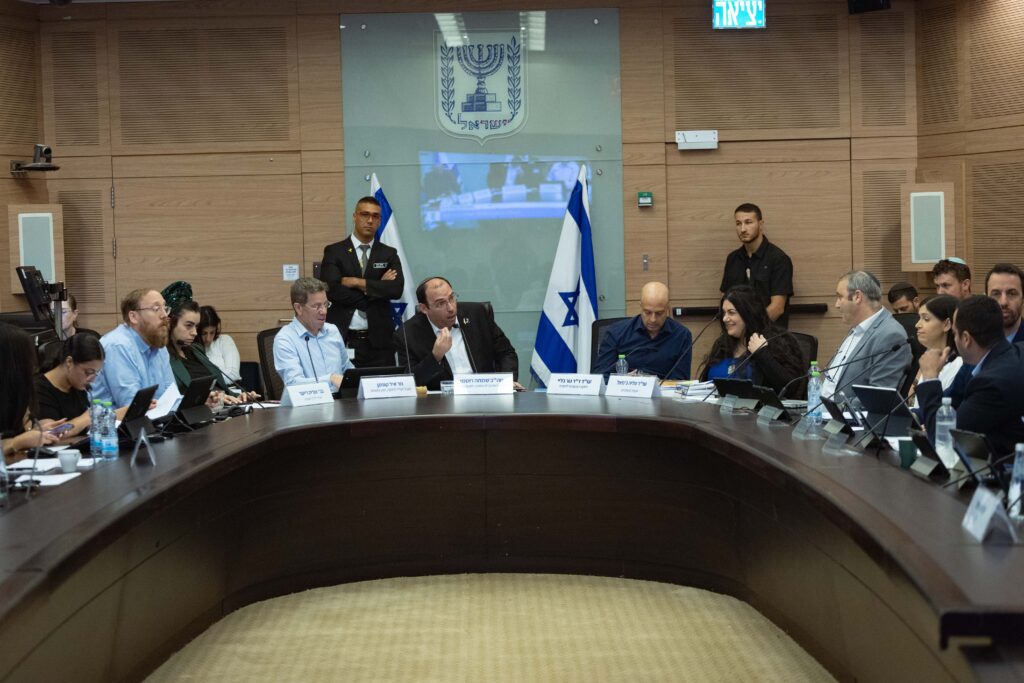
The Central Elections Committee has been under significant right-wing pressure for months. As a result, its long-serving general director stood down after 15 years in the position. The committee’s chairperson is now the vice-president of the Supreme Court, Noam Sohlberg, a conservative judge close to settler groups. Despite his political background, he is by no means immune to hostility from right-wing camps. In June of this year, ultra-orthodox demonstrators opposed to his position on compulsory military service stormed his family home, smashed windows, and damaged his car – a foreshadowing of what might happen if the right-wing parties lose the elections.
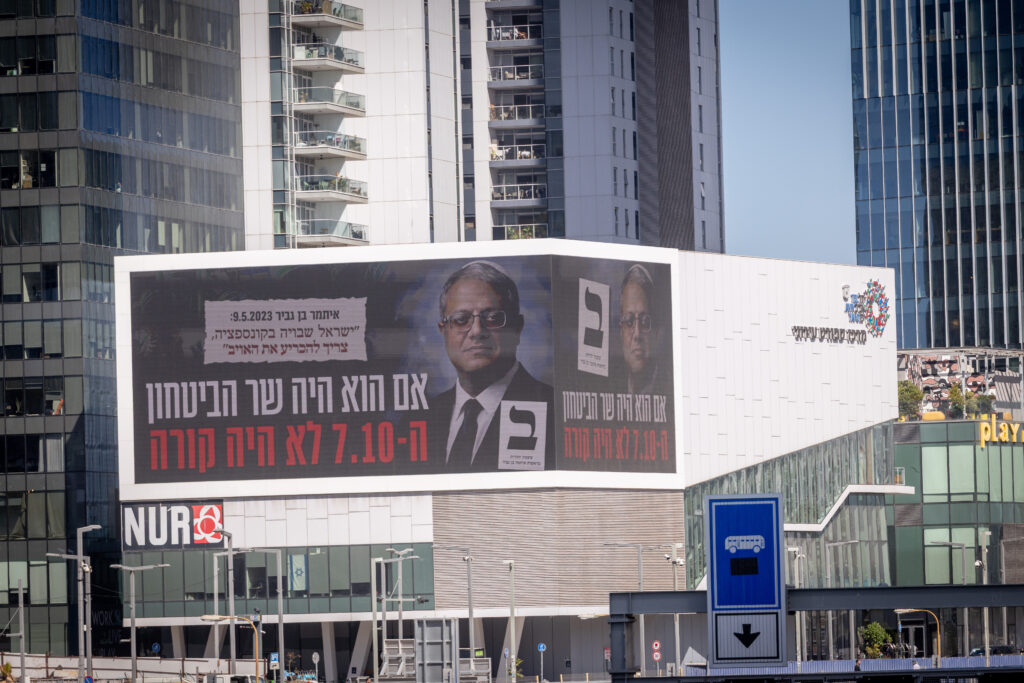
A further threat that many Israelis are concerned about is the police, which the Minister for National Security, Itamar Ben-Gvir, has brought completely under his control. The police could intervene on election day – for example by being present outside polling stations in Arab cities and neighbourhoods or by policing alleged irregularities in polling stations. There is also the possibility that, as has happened in the past, the police allow right-wing paramilitaries to patrol the streets. On election day, the police and paramilitaries could thus intimidate voters, block polling stations, or disrupt vote counting.
How the Palestinian parties will respond after the elections remains to be seen. On the one hand, all are emphasising their resolve to bring down the current government; on the other, many have reservations about helping Bennett, a former director of the Yesha Council (an umbrella organisation for Jewish settlements), or Eisenkot, a former IDF chief of staff, to win office.
Moreover, at the end of September, the election committee – a political organ directed by the Central Elections Committee director Sohlberg, in which all factions have voting rights – voted to exclude the (predominantly) Arab parties Joint List and Ra’am, effectively ruling out political representation for a fifth of the population. The Supreme Court ultimately revised the exclusion; yet the committee’s decision shows how far the attacks on free and fair elections have already gone.
In light of this, the possibility cannot be ruled out that Netanyahu is following Trump’s play book and will not recognise the election result if he is defeated. The foundations for such a response are already being laid: institutions are being systematically delegitimised, trust in public bodies is being deliberately undermined, political opponents are being slandered as “traitors”. AI-generated misinformation is also being spread en masse on social media and in Telegram channels.
Opposition groups and civil society are preparing for possible scenarios. Numerous parties have set up task forces of lawyers and former police officers, and civil society initiatives are coordinating a network of almost 20,000 election observers.
Far from a Majority
It is highly surprising that the Netanyahu government has managed to survive a full term. Recall that five elections were held between April 2019 and November 2022. The fact that the coalition survived so long is not due to its political strength; rather, the fact that they would not have secured a majority in the case of new elections forced the governing parties to remain together come hell or high water.
The fact that the coalition was so far from a majority is due to the broad resistance to the authoritarian transformation of the state – and in particular to the so-called judicial reforms, which sought to strip a wide range of powers from the judiciary. There were also the unpopular pet projects of the various coalition partners: the settler parties (Otzma Yehudit and HaTzionut HaDatit) wanted to continue pursuing their “Greater Israel” plans, the ultra-orthodox parties (Schas and the religious anti-Zionist Yahadut HaTorah) want to permanently exempt their followers from military service, and Likud was aiming to shut down the criminal investigations of Netanyahu.
The opposition failed to capitalise on all of this. Despite massive, month-long protests against the judicial reforms, and despite the pressure of the hostages’ families during the Gaza war, they failed to bring down the government. On the contrary: after October 7, Netanyahu’s challenger Benny Gantz even temporarily joined the war cabinet, and Gideon Sa’ar – once a vocal critic of Netanyahu within Likud – and his party joined the ruling coalition. Moreover, any criticism of the Israeli wars came under severe pressure. That weakened the opposition in a lasting way.
Government and Opposition
In the past, Netanyahu was able to consolidate his allies before every election. In situations with narrow majorities, and given the election threshold of 3.25 percent, elections may be decided by very few votes. To this end, Netanyahu welcomed Ben-Gvir – previously convicted of supporting the Kahanist Kach movement, which is a designated terrorist organisation – into his alliance and thus also into the political mainstream.
Yet Netanyahu’s consolidation efforts were not so successful this time. The Netanyahu camp is going into the elections with three parties that may not pass the election threshold. Moreover, the Likud brand has become toxic for up-and-coming politicians, such that this time Netanyahu failed to win over high-profile candidates for the Likud ticket.
The centre-right opposition has formed two alliances. One was formed by former IDF Chief of Staff Gadi Eisenkot together with the Yashar (“Straight”; also “Upstanding”) party. The other is the BeYachad (“Together”) alliance formed between Naftali Bennett, a religious-nationalist politician, and the liberal opposition leader Yair Lapid. Both were briefly in government in 2021–22.
Eisenkot and Bennett both position themselves as alternatives to Netanyahu and want to explicitly attain a “Zionist majority”. That excludes Arab parties, despite the fact that a change of government without their support seems mathematically almost impossible.
Left-Wing and Arab Parties
The Israeli left is very weak, but certainly present. In the polls, HaDemokratim (“The Democrats”), a merger of the left-wing Zionist Meretz and the social-democratic Haavoda (“Labour”) parties, are on track to win ten seats – the most since 2021. The alliance is led by former IDF Major General Yair Golan, who became well-known in 2016 for a speech he gave on fascist tendencies in Israeli society. His past military career enabled him to put forward anti-war views in a way that was palatable to voters from the Jewish-Zionist social majority; at the same time, his commitment to a “politics of strength” encountered resistance from the non-Zionist left-wing spectrum. Anti-occupation and anti-war voices come predominantly from the former Meretz camp and remain a minority. Nonetheless, HaDemokratim is the only opposition party that advocates for cooperation with Arab parties.
The Joint List, an electoral alliance of the socialist Hadash party and the Palestinian-nationalist Ta’al and Balad parties, appears to be set to win around seven seats in the polls; the Ra’am party, running alone this time, is polling at around five seats. Ra’am is building on its experiences of governing in 2021–22 and is pursuing a policy of reaching out to the Jewish social majority. To this end, in December 2025, the party severed its ties to the Islamic Movement in Israel (Shura) and placed its first Jewish candidate, the former Yesh Atid Knesset member and Deputy National Security Minister Yoav Segalovitch, in second place on its list.
Between HaDemokratim and Joint List there is the Makom LeKulanu (“A place for us all”) party, which emerged out of the Jewish-Palestinian grassroots movement Standing Together. Yet as the party was in danger of failing to make the electoral threshold, it withdrew its candidacy.
The Future of Israeli Democracy
For months, polls have shown the same scenario: of the 120 seats in the Knesset, Netanyahu’s coalition may secure around 50, the Jewish-Zionist opposition almost 60, and Arab parties 10-12. Yet if all the small parties in the Netanyahu camp succeed in passing the election threshold, the two main factions may be more or less equal (with both lacking a majority).
Currently, there are three possible election scenarios: 1) Netanyahu wins through repression or vote-buying, or refuses to acknowledge the results; 2) the opposition forms a stable – or a merely tolerated (possibly minority) – government; or 3) no group can secure a majority, and new elections are held.
For Israel’s fragile democracy, the first scenario, in which Netanyahu and his coalition partners remain in office, would be disastrous. In that case, the judicial reforms could be quickly revived; the ongoing wars would also likely increase in intensity.
Yet voting out Netanyahu’s coalition also won’t solve the country’s problems. The Jewish-Zionist opposition parties have largely supported the occupation and the military escalations seen in recent years. Large swathes of the liberal-Zionist mainstream would be satisfied by the restoration of the status quo prior to the judicial reforms, complemented if need be with military service for ultra-orthodox people and a State Commission of Inquiry into October 7.
By contrast, a true alternative would have to catalyse a transformation that would be radical by Israeli standards: abandoning faith in Jewish supremacy, the reconstruction of a functioning welfare state, a serious commitment to the peace process with the goal of ending the occupation and recognising a Palestinian state, as well as cooperation based on equality. Only the abandoning of the project of a Greater Israel will make possible a democracy that is worthy of the name.
This article was originally published in German by “nd.aktuell” as part of as part of a collaboration with the Rosa Luxemburg Foundation.