“Tell me, Michael, is there any chance that if we file this petition, they’ll retaliate against us?”
Hassan’s (a pseudonym) charismatic smile gradually faded. At “Tell me,” he was still smiling; by “retaliate against us,” he grew solemn.
We’ve known each other for 20 years. When I first met him, he was just shy of 30 and already the prominent figure in his village, the mover, the shaker, the person who stepped up when troubles rained down on the community like poisoned manna from above. If he were Israeli, he’d surely be the chairman of some major labor union, if not a Knesset member who rose up from grassroots activism.
When it came to advocating for the village’s interests before officers of the Civil Administration, the military body that manages much of the everyday life of Palestinians in the Occupied Palestinian Territory (OPT), Hassan was the obvious choice. When lawyers representing village residents needed a contact person, Hassan was appointed. And when delegations from interna-tional aid organizations came to the village, it was a given that Hassan would be the one to tell them the community’s story. Thanks to his sharp mind, fluent Hebrew, and the fact that he came from a prominent family in the village, he held the ambiguous title of village council secretary. The title might be vague, but in practice, Hassan ran the show.
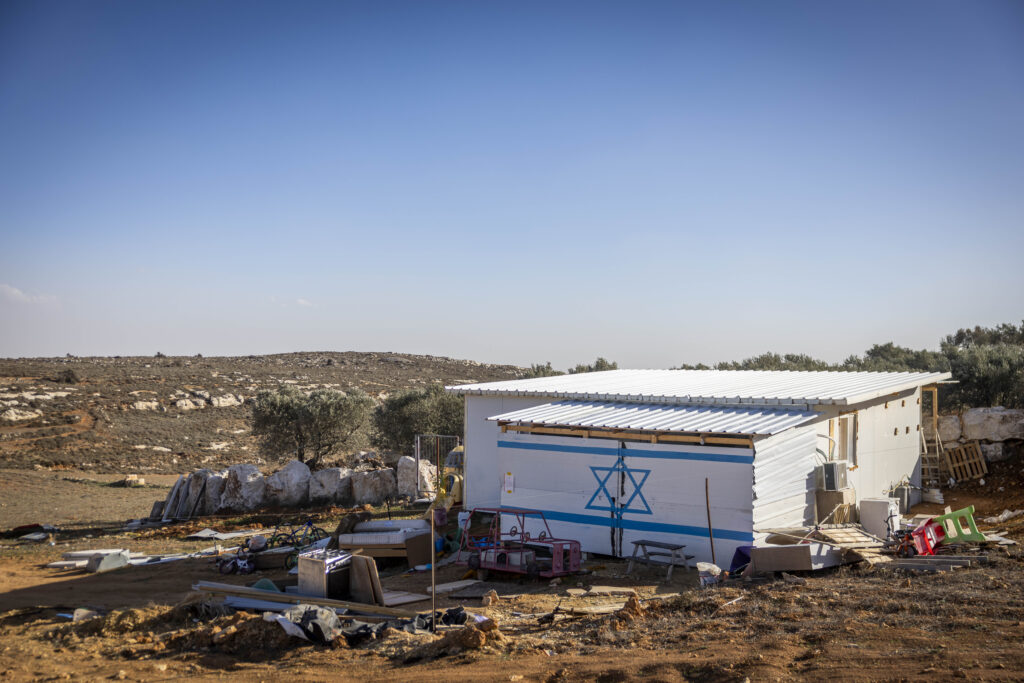
Hold on, did I say “village”? For years, the State Attorney’s Office insisted on referring to Arab a-Ramadin a-Janubi, the community of 400 people where Hassan was born, raised, and lived his whole life, as a “cluster of structures.” On a particularly magnanimous day, a “compound,” but a village? Never.
Was the petition I was about to file putting the village at risk? Could the authorities punish its residents for their audacity, for taking legal action? If Hassan and his neighbors were Israeli, I’d have said to him, instantly and with-out a second thought, “No way!” But they aren’t Israeli.
I remembered the scene that unfolded before me on my first visit to the village, the view seen from the road leading to Ramadin, and I wondered how many travelers even notice the dissonance between the two sides of the road. Wait, I misspoke again. Did I say the road leads to Ramadin? Apologies. The road leads to the settlement of Alfei Menashe, with an improvised, hazardous exit to the dirt path that winds among the tin shacks and the bare concrete skeletons of Ramadin. Approaching the village from the west, through the windshield, you can see, at the same time, the homes of Alfei Menashe to the right, red-roofed, arranged in arched rows facing the view, and the shantytown that is Ramadin to the left, structures scattered on a hill with no planning and infrastructure whatsoever. If Israeli apartheid had a profile picture, it would be the view of Ramadin and Alfei Menashe.
Hassan poured more tea. We were sitting in his shaded yard, and I was holding the power-of-attorney forms and affidavits he had just signed for a petition we were preparing to file with the Jerusalem District Court. In that petition, we demanded that the Civil Administration, which, despite its name, is a military body that acts as the government of the Israeli occupation regime in the West Bank, approve a master plan for Ramadin. Though the village has existed for decades, long before Israel occupied it, it has no such plan, which means that formally nothing built there is legal. Many of the homes have demolition orders against them. That’s why life for all the residents of Rama-din is forever provisional.
“I’m asking seriously, Michael.” Hassan saw I wasn’t answering. “In the past few years, there haven’t been too many demolitions here, except for the mos-que, so before we file, I want to know what you think: Couldn’t this petition prompt them to carry out more demolitions?”
Ramadin is a Bedouin tribe. Residents of the village are refugees from the Lakiya area in the Negev Desert, who, in 1948, with the establishment of the State of Israel, were forced to flee to the West Bank. They purchased a hill south of the Palestinian city of Qalqilya, in the center of the West Bank, right next to the Green Line, the 1949 Armistice Line between Israel and Jordan that marks the boundary of the West Bank. They have lived there ever since. In the 1980s, the Israeli settlement of Alfei Menashe was built next to the community and took over most of its pastureland. At the turn of the millennium, Israel erected the separation barrier, whose route wound its way around Ramadin, physically cutting it off from the West Bank from the north, east, and south. That’s how the residents lost their access to Qalqilya, which, until the barrier went up, was within walking distance from the village and supplied every basic service, education, healthcare, work, and commerce. The enclave they’ve been trapped in is sealed off to the west by another, invisible legal fence: the Green Line. Crossing it and entering Israel without a permit is a criminal offence.
I met Hassan and his neighbors when construction of the separation barrier was complete. At first, I represented them in a petition against its construc-tion, and in the years that followed, in Sisyphean battles to allow living in the enclave it created. When Hassan introduced himself to me as secretary of the Ramadin Village Council, I remember thinking to myself that as far as the CivilAdministration officers are concerned, there is no village, and if there is no village, then there is no village council, which means here’s an odd man going around introducing himself as the secretary of a fictional body.
Anyone familiar with the Israeli occupation knows that not all occupied are born equal; some are more occupied than others. In Ramadin, the occupation is supermax. The Civil Administration controls everything. They need a permit just to keep living on their hill, in their enclave, to leave it by car, to enter it with supplies, to breathe. When a donkey wandered out of the village and blocked the road to Alfei Menashe, the settlement’s residents cut off Rama-din’s water. When the people of Ramadin scraped together every penny they had to build a mosque, because they couldn’t reach mosques outside the enclave, residents of Alfei Menashe pulled some strings, and the Civil Admin-istration made demolishing the mosque a top priority. The day I met Hassan to discuss the petition for a master plan for the village, the mosque was already a pile of rubble.
Over the years, the military has taken full advantage of the villagers’ total dependence on it, making every effort to make their lives miserable in order to push them to move to a location offered to them east of the barrier. This would make the enclave created for Alfei Menashe Palestinian-free. If you move, you’ll have nice houses made of stone, not shacks, they were told. But the residents of Ramadin steadfastly refused. They had been refugees once; they were not ready to become refugees again. Because the village is unrecognized, Civil Administration-issued ID cards list residents as residents of Qalqilya, the city now cut off from them by the barrier.
“Unfortunately, I can’t guarantee anything,” I finally responded to Hassan’s question, frustrated. I thought about a petition I had filed for two other villages near Alfei Menashe, requesting to move the route of the separation barrier to let them out of the enclave prison. Mysteriously, demolition orders were quickly issued for the homes of the named petitioners who’d been randomly chosen as their communities’ representatives. “But I do worry, Hassan, that if we don’t file a petition, at some point, they’ll come and demolish everything. In the end, you know, they just don’t want you here.”
How on earth can it be that I, an experienced lawyer who is fairly well- known in both the state attorney’s office and military advocate general sys-tem, can’t assure my clients that the regime won’t hound them just because they initiate legal proceedings in the regime’s own courts? As we had discov-ered in the months before, the residents of Alfei Menashe have the connec-tions to make the people with guns and D9 bulldozers tear down a mosque built in Ramadin. The people of Ramadin have no such connections. They are not citizens of the country whose military runs the Civil Administration. They have no representatives in the Israeli parliament, the Knesset, in government, courts, or in the bureaucracy. In my lifetime, I’ve voted 13 times for the Knesset (five of those in just three years, during the political dumpster fire that dragged Israel into a series of elections from 2019 to 2022). Thirteen times, I have chosen representatives to participate on my behalf in lawmaking, in set-ting the norms that govern my life and my family’s. In all that time, Hassan never voted once, except perhaps for his “village council,” which, for the authorities, is equivalent to an imaginary friend.
Hassan’s life is completely controlled by a military commander, who is gov-ernment, legislature, and judge, all rolled into one, a single, all-powerful gov-erning authority. The military commander decides if Hassan can build a house, if he can take a vacation abroad, how much VAT he pays, and what punishment he’ll get if he breaks the law. The military commander can, at will, revoke Hassan’s permit to live in his village and issue and execute a demoli-tion order on his home. He can detain Hassan without trial indefinitely (in a procedure called administrative detention). There is no separation of powers, no majority and minority, just an absolute ruler and powerless subjects.
Hassan has no access to the regime that rules him, no leverage. He is nobody.
∵
A 20-minute drive west of Ramadin, nearly 200,000 protesters gathered in Tel Aviv. The human tide stretched more than one kilometer along Kaplan Street, a name that would later become synonymous with the wave of protests that erupted in Israel in the beginning of 2023 and with the protesters themselves. A group of young children, led by a mom, sang a modified version of the child-ren’s action song “My Hat, It Has Three Corners.” It went like this: “My country, it has three branches of government.” Delighting protesters, the children con-tinued: “and had it not three branches of government, it would not be my country.”
Week after week, often more than once a week, hundreds of thousands took to the streets and intersections, blocked major traffic arteries, and protested everywhere government ministers or coalition Knesset members showed up. Netanyahu’s sixth government looked to the past and drew the wrong conclu-sions about how passionate Israelis who didn’t vote for them were about liberty.
It would be unfair to mock the coalition of fascists, racists, and crooks for failing to anticipate the protest that crashed against it and its members with stunning force. In 2023, the prevailing sociological model of Israeli society was blown out of the water. You could not find a single expert on Israeli society who wasn’t shocked to the core of their expertise by the sheer energy that exploded at the start of the year against the constitutional coup the Israeli government declared, and by the sustained civil resistance it sparked. That winter, which turned into spring and then a sweltering summer, those schol-ars discovered their core understandings about the political DNA of Israeli society, which they had studied, taught, and written about for years, were completely wrong. It turned out that the segment of Israeli society stereotyped as café and restaurant dwellers held within it enormous power and a willing-ness to fight when faced with a tangible internal threat. It turned out that under the veneer of hedonism and bread-and-circuses addiction, there is a burning core, unwilling to give up living in a political order that sees itself as an open, democratic society, respectful of liberty and equality.
And so, through those turbulent months, many protesters kept on frequent-ing bars and cafés, only now, they showed up with flags and protest signs, as if to say, we’re on our way to a demonstration, or just coming back from one. In any case, we’re sleeping with our shoes on, because any minute now we might be called to rally outside a police station holding a detained protester.
Of course, protesters weren’t just hedonists from Tel Aviv. The govern-ment’s open war on the system of governance that shaped Israel up to its swearing-in rattled Israeli society far and wide, forging coalitions between sectors no one would have imagined standing side by side at the same rally: suburbanites and city folk, the business sector and the security sector, blue- collar workers and academics, farmers and high-tech professionals.
What brought together all these people with no common economic or political viewpoint? What identical instinct burst out of people whose identity is tied to their military careers and women’s and LGBTQ rights activists? What terrible threat sent the business elite and wage workers who barely make ends meet into a cold sweat?
To me, the answer is obvious: they were all afraid of becoming Hassan. There is no way in the world they’d put up with becoming Hassan. Not Hassan, not half of Hassan, not a quarter, not a tenth.
That’s why they took to the streets. And it’s one reason why Palestinian citizens of Israel didn’t. They’re already somewhere between a quarter Hassan and half Hassan. Jewish Israeli protests were fueled by the horrifying prospect that the government would change the constitutional structure such that no right would be guaranteed and no liberty carved in stone. A system where the separation of powers would be shattered and judicial independence crushed, where power would be concentrated in the hands of a single authority, maybe a single person, effectively unaccountable to anyone or anything. That’s why the masses took to the streets and stayed there for months. It was a fight for freedom.
That is why, without a doubt, people from Alfei Menashe were among the hundreds of thousands who marched. They knew better than the aver-age Israeli how miserable it is to be Hassan. In the 2022 elections, about half the votes in Alfei Menashe were cast for parties that did not join the Netanyahu–Ben Gvir–Smotrich coalition.
Israel’s thirty-seventh government created the perfect storm. A concoction of nationalist, messianic, racist, chauvinist, anti-LGBTQ, and corrupt world-views took hold of the reins of power, steering a clearly and overtly anti- democratic agenda. Netanyahu’s coalition partners swooped in like starving predators who suddenly found themselves surrounding a fawn, foaming at the mouth, sensing that this time, all their fantasies were within reach; not just within reach but set to last, a chance to rewrite the rules for good.
The ultra-Orthodox parties sought to enshrine in law the exemption of yeshiva students from military service once and for all, to dramatically increase public subsidies for their institutions, and to shift the balance between indi-vidual freedom and equality, particularly gender equality, and respect for their religious beliefs in public spaces. Netanyahu’s loyalists set out to undermine the judicial system, weaken it to the point of canceling the prime minister’s corruption trial, to remove legal shackles that prevent attacks on publicly funded pluralism and restrict the appointment of cronies to public positions, and, in general, to wield their victory as it was done in biblical times: to erase the vanquished, their culture, their values. The settlers set their sights on full, final annexation of the West Bank, flooding it with Jews, pushing Palestinians permanently into their urban enclaves, maybe even expelling them, and legally and constitutionally cementing Jewish supremacy everywhere between the River and the Sea.
The Netanyahu coalition leaders understood that the government’s legal advisers and the High Court of Justice are the main, if not only, barrier to most of their ambitions. Under Israel’s current system, just about the only check on the power of a parliamentary majority is judicial and constitutional review, exercised by Israel’s justice system, chiefly, the Supreme Court sitting as the High Court of Justice (HCJ). The court’s jurisprudence gives power to the legal advisers, who determine if an administrative action is improper: if the decision was influenced by extraneous considerations, whether it consti-tutes overreach, involves discrimination or lacks a factual basis, and whether the considerations behind it are manifestly unreasonable. In exercising con-stitutional review, the court decides whether a law violates fundamental rights disproportionately or in pursuit of an improper purpose and should, therefore, be struck down.
This is why the leaders of the ultra-Orthodox parties knew that a full con-scription exemption for students in their schools, along with sweeping subsi-dies for yeshiva students including living stipends, would face a strong leg-al argument about blatant discrimination when compared with non-ultra- Orthodox youth, who are required by law to serve in the military, and students who must work, sometimes at several jobs, just to cover their living costs. Netanyahu’s loyalists knew that as long as the heads of the legal system, espe-cially the justices of the Supreme Court, the attorney general, and the state attorney, were independent professionals and not political appointees, the political system would stand no chance of controlling Netanyahu’s court cases, and dreams of giving cronies public appointments for their loyalty would not come true.
The fascist–racist–settler wing of Netanyahu’s government, however, should have known from past experience that the HCJ would never really stop any of their nefarious pursuits in the OPT. It might slow them down, but it would not block their crimes. Take, for example, the steps taken to expropriate land from Palestinians in order to expand settlements and retro-actively approve outposts (in Israeli jargon, “outposts” are settlements estab-lished without formal government approval and the required building per-mits, hence officially illegal even in terms of Israeli law).
In 2017, the Knesset passed the Regularization Law, which shamelessly stip-ulated that privately owned Palestinian land invaded by settlers would be expropriated and allocated to the trespassers. The HCJ did block this brazen attempt at land robbery in broad daylight, and the justices struck down the law in a case in which I had the honor of representing some of the petitioners. However, in countless other rulings, it sanctioned a slower, more nuanced bureaucratic takeover (sometimes lasting years) of Palestinian land on a mas-sive scale. It has also, in effect, upheld government and Civil Administration policies of allocating land taken from Palestinians exclusively to settlers.
The previous generation of settler leaders took a conservative political approach and believed in long-term, gradual change. That’s why they didn’t mind taking the slow, long, legalistic route the HCJ imposed to pursue their goals. After all, as the popular Israeli saying goes, “the People of Israel are not afraid of a long journey.” Not so this generation. The current political leaders of this camp, Finance Minister Bezalel Smotrich, National Security Minister Itamar Ben Gvir, and Chair of the Knesset Constitution, Law and Justice Com-mittee Simcha Rothman, are not conservatives. They’re revolutionaries. They want everything, and they want it now, and in their mad dash toward the finish line, the HCJ is a pebble stuck in a shoe.
Every element in Israel’s thirty-seventh government coalition had its own interests and expectations that demanded dismantling the legal system, crush-ing the HCJ, and turning legal advisers into yes-men who will do whatever elected officials tell them.
∵
Those who protested against the constitutional coup are probably letting out a scoff at this point. Is this what the author is trying to peddle? That the protest was an exercise in hypocrisy because, just 20 minutes from where it took place on Kaplan Street in Tel Aviv, an Israeli regime that is exactly what we’re trying to save ourselves from has been in place for six decades? No separation of powers, no checks on majority rule (not that it is majority rule over there, just overlords ruling), no rights. Are you asking where we’d been all those years, and why we didn’t wake up until the winter of 2023, because suddenly it’s our rights under threat? Classic leftist preaching.
No, no. I swear that is not my intention (though the analysis I allowed myself to put in your mouth does have merit). The argument that the connec-tion between the occupation and the constitutional coup lies in some similar-ities the regime in Israel would bear to it, should the coup succeed, is superfi-cial. It ignores much deeper layers. Besides, foreign occupation and domestic dictatorship aren’t alike. It may very well be that all democracies share the same beauty, while every dictatorship is ugly in its own way.
Understanding how the occupation is related to the coup starts with under-standing what occupation is and then getting familiar with Israel’s version of it. It requires getting familiar with the toxins it has released into the Israeli body over the years, and continues to release in ever-increasing doses, the tumors it grew, how it metastasized. It’s not for nothing that Netanyahu’s coalition is pursuing two coups.
The constitutional coup may have hogged all the airtime in Israel, and, at the time, to a large extent abroad, too, but it is not alone. The Israeli govern-ment carried out, at the same time, a second, equally radical coup with far- reaching consequences: a fundamental change in the regime structure and administrative powers in the West Bank, which amounts to full legal annex-ation.
The two coups happened simultaneously. Both, not just the first, were designed to transform the Israeli system of government beyond recognition. Everyone in Israel knows about the first, and the fire it sparked has largely hidden the second from the Israeli public. The details of the second coup were explicitly stated in the coalition agreements. It is the pet project of settler representatives and their supporters in government, and for want of a deter-mined struggle against it by Kaplan protesters, it has been pursued with remarkable speed. Its finish line is the completion of a process, steadily advancing for five and a half decades, of transplanting the West Bank into the Israeli body while consolidating Jewish supremacy. And if that happens, even if Netanyahu and his gang don’t take over the justice selection commit-tee (one of their main goals as they bid to appoint ideologically amenable judges), you can kiss democracy goodbye.
∵
“Did it have to turn out this way? Was this inevitable?”The deep sadness in Kathleen’s voice threw me off.
“Did what have to turn out this way?” I asked, pretending not to under-stand, while actually buying time to think of an answer.
Kathleen had just returned from a tour of the West Bank led by Yehuda Shaul. Yehuda is one of the founders of Breaking the Silence and among the most dedicated and effective activists in the struggle against the occupation. As an infantryman in the early 2000s, he spent much of his military service, both as a soldier and as a commander, in the city of Hebron. Yehuda, who comes from a Haredi family, is something of an outsider everywhere he goes. In Hebron, he saw what countless soldiers before him had seen, the occupa-tion in all its ugliness. Unlike most, who locked these scenes away in the far-thest recesses of their mind, hoping never to think of them again, he couldn’t ignore the scar the occupation in the City of the Patriarchs had left in him. Even before his discharge, he began what would become his life’s mission: to expose the reality of the occupation to the Israeli and international public through soldier testimonies.
It started with a photography exhibit in Tel Aviv. Photographs taken by soldiers during their service in Hebron were displayed alongside testimonies about violently enforcing oppressive control over a civilian population of tens of thousands of Palestinians, while complying with the demands of another population: the hundreds of Jewish settlers living in the city. A few days after the exhibit opened, the military police raided it and detained the organizers, including Yehuda, for questioning, hoping to discover the names of the sol-diers who gave testimony. To the investigators’ disappointment, the unre-dacted testimonies, with the witnesses’ personal information, had already been secured in a safe in my office, and the organizers asserted that on the advice of their lawyers, they were entitled to journalistic privilege regarding the sources’ identities. An outrageous attempt to persuade a judge to autho-rize a search warrant for my office failed, but that’s a story for another book.
The exhibit, called “Breaking the Silence,” became an organization whose core activity, even now, more than 20 years after its founding, is publishing soldiers’ testimonies about the daily mechanics of occupation. Breaking the Silence also offers educational tours, mainly to Hebron but also to the South Hebron Hills. At some point, Yehuda put together a broader tour that tells the story of the occupation across the entire West Bank. Kathleen had just returned from one of these.
Attorney Kathleen Peratis is a prominent feminist attorney in the United States. In 1974, Ruth Bader Ginsburg hired Kathleen to succeed her as head of the Women’s Rights Project at the American Civil Liberties Union. Ginsburg was a legendary women’s rights litigator and later a legendary justice of the US Supreme Court. Ginsburg and Peratis conducted some of the most successful and groundbreaking legal battles in the field of women’s equality. When Per-atis left the staff of the ACLU, she continued her activism as chair of the New York Civil Liberties Union, founded the Women’s Rights Division of Human Rights Watch, and served as co-chair of the advisory committee of the Middle East North Africa Division of Human Rights Watch. Until recently, she was a senior partner in the New York law firm Outten & Golden, and she continues to represent victims of gender discrimination as well as on other grounds in workplaces.
Although Kathleen visited the Occupied Palestinian Territory plenty of times over 25 years, she found the tour with Yehuda especially depressing. On the minibus heading back across the Green Line, surrounded by several human rights activists, she came to a startling realization. It was a profound paradigm shift.
“I mean, was it inevitable? Was this monstrous policy inevitable? Is this what Zionism was bound to become?”
Kathleen’s question struck a dormant nerve, bringing to the forefront some-thing I had long dreaded asking myself, despite decades of experience with the occupation and the harm done to its Israeli opponents. Can a country defined as a Jewish nation-state inevitably create anything but an apartheid system for Arabs and a dictatorship for leftists?
We continued the conversation the next day in my office, where I eventu-ally gave my answer. After all, I am a lawyer, and my profession is all about quick thinking and convincing responses. But in truth, I kept turning this question over in my mind for years afterwards. The answer is anything but simple, and it is influenced by our knowledge of the reality shaped by Zionism.
But before we analyze cause and effect, it is first necessary to gain an under-standing of the outcome. To draw any conclusions about the values underly-ing the Israeli project from the occupation, one must first learn and under-stand the occupation’s features. Only then can the necessary insights be extracted. So, before I go into the answer I gave Kathleen, it’s important to get to know the features of the Israeli occupation a little better.
The English language edition of Occupation From Within: How Israel’s Oppression of Palestinians Turned Inwards was published by De Gruyter in 2026