A few weeks ago, an image went around the world: Israeli soldiers capturing Beaufort Castle, a Crusader-era fortification in southern Lebanon, and hoisting the Israeli flag as a symbol of dominance on a strategically vital and politically charged site of Lebanese cultural history.
Over the past two-and-a-half years, Israel’s military excesses have made it increasingly clear that the Israeli government is pursuing a “Greater Israel” policy. The term “Greater Israel” has thus also found its way into media analyses of Israeli war policy. The prevalent interpretation draws out links between Greater Israel policy and the representatives of messianic settlers in the Israeli government and the government’s de facto policy of annexation in the West Bank, as well as the (re-)settlement plans for the almost completely devastated Gaza Strip.
Beyond these links, the expression “Greater Israel” (from the Hebrew for “the whole land of Israel”) is also being applied to Israel’s military occupations in southern Lebanon and in Syria’s frontier to the Golan Heights, which Israel annexed in violation of international law. This is the dimension that I will be analysing in this article.
“Gazafication” of Southern Lebanon?
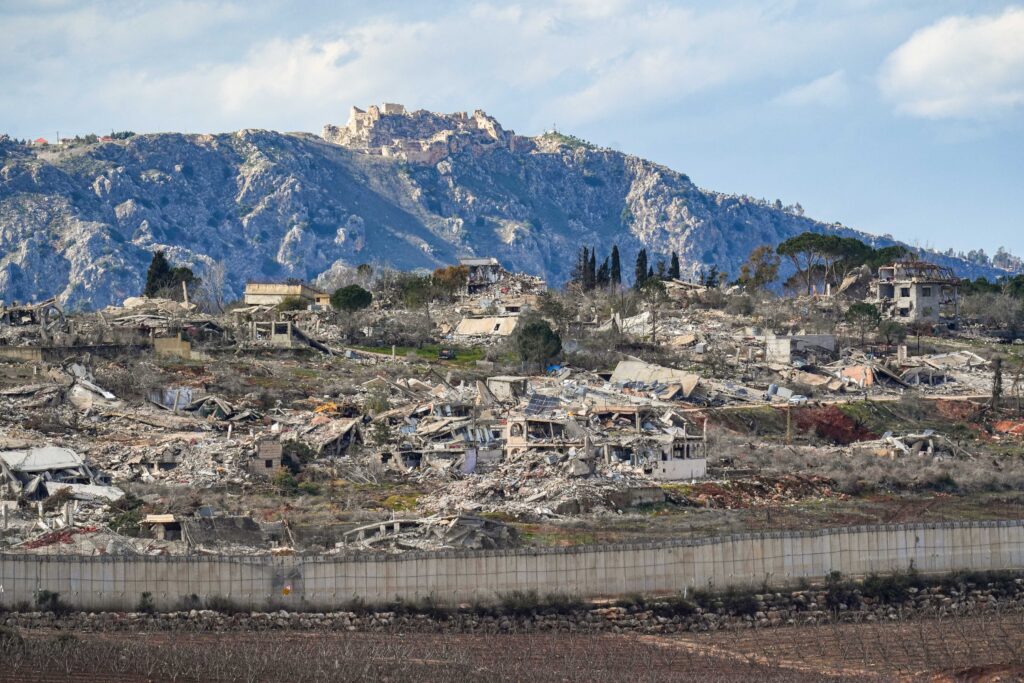
In Israel, too, voices drawing attention to this broader policy are growing ever louder. There are those who interpret the destructive military presence and occupation regimes in south Lebanon and the south of Syria as elements in a Greater Israel project being pursued by the Israeli government; some also see the two offensives against Iran in 2025 and 2026, in contravention of international law, in the same light. Others even go so far as to describe such a project as integral to Israeli political practice beyond Israel’s northern border. Particularly the actions of the Israeli army in — and statements by government ministers about — south Lebanon recall the destruction wreaked in the Gaza Strip since October 2023. A report recently published by the Lebanese documentation collective Public Works in collaboration with medico International demonstrates the systematic character of the destruction of public infrastructure. The documentation bears a strong resemblance to reports from the largely devastated Gaza Strip, which has led some to speak of a “Gazafication” of Lebanon’s south.
The present Israeli occupations in southern Lebanon and the south of Syria exhibit a number of elements (such as occupation, destruction, displacement, etc.) that have hitherto been associated primarily with Israel’s settler-colonial expansion in the West Bank and the Gaza Strip. Taken together with the increasingly commonplace calls from politicians (including the opposition) and from settler organizations like Uri Tzafon (“Awake, O north wind”) for a permanent territorial re-ordering of the northern border, the occupations in Lebanon and Syria support the impression that the Greater Israel ideology now projects its political effects further afield, also encompassing areas beyond historical Palestine. Precisely for this reason, it is worth taking a historical look at the scope and limits of this interpretation.
Even a look at the original Hebrew terminology (“the whole land of Israel”) can suggest the strength of this ideology’s influence, which reaches far beyond messianic and fundamentalist circles in the Zionist movement. The interpretation of Israel’s current military expansionism as aligned with an idea of Greater Israel lying at the core of Zionism is made first and foremost with reference to Biblical texts. Thus, according to Genesis 15:18–21, God promised the territory from the Nile (in today’s Egypt) to the Euphrates (in what is now Iraq) to Abraham and his descendants. In the course of the emergence of the Zionist movement, this Biblical idea was sometimes taken up in the writings of early Zionist thinkers, but it became neither the dominant territorial narrative nor the prevalent conception within the New Yishuv, the movement of early Zionist settlers that took shape in reaction to widespread antisemitism in Europe. Internal political differences notwithstanding, the latter was united in focusing primarily on settlement in and territorial control over what was then the British administrative territory of Mandatory Palestine.
Since that time, the claim laid by the Zionist movement to “the whole land of Israel” has been so deeply inscribed in Israeli society that by now the ongoing policies of occupation, expulsion, and settlement meet with ever more negligible internal opposition. Israeli expansion, occupation, and control over parts of Lebanon and Syria — and as we know, for several years after the June 1967 war, Israel also occupied parts of Egypt in the Sinai Peninsula — have now been subject to unprecedented normalization as a rightful corollary of the Zionist movement’s historic territorial aspirations.
The Golan Heights as a Blueprint?
The Golan Heights, occupied by Israel in June 1967, form an important exception here, and in a certain sense also provide the template for what can result from an occupation pursued for “security reasons” and in the absence of meaningful pushback internationally. In this case — by contrast with the occupation of the Sinai Peninsula that same year — a military occupation initially legitimated by reference to security policy was retrospectively overlaid with a Zionist narrative, such that, from today’s Jewish-Israeli perspective, the Golan Heights are also viewed as comprising a “natural” part of the legitimate territory of the Israeli state. This shift in perspective took place despite the fact that Israel’s subsequent annexation of this stretch of land in 1981 made no difference to the occupation’s illegality under international law as determined by the United Nations.
The example of the annexation of the Golan Heights, which was recognized in 2019 by the first Trump administration, goes to show what can happen when Israel pursues territorial expansion in the absence of international pressure: over the years, an argument based on security policy (a buffer zone against the threat emanating from Syria) gets entangled with a nationalistically inflected discourse in which the territory is seen as an historically legitimate component of Israeli territorial control, particularly given that the military capture of the Golan Heights (in Arabic: al-Jolan) already involved the expulsion of the vast majority of its Syrian inhabitants (with the exception of Druze communities).
The case of southern Lebanon can also be invoked to show that — putting the obvious breach of international law to one side for a moment — long-term Israeli occupations in neighbouring countries do not necessarily lead to territorial expansion with permanent expulsion and settlement. In 2000, Israel, which had occupied the site mentioned at the beginning of this article, Beaufort Castle, for 18 years, withdrew from southern Lebanon under mounting domestic and international pressure.
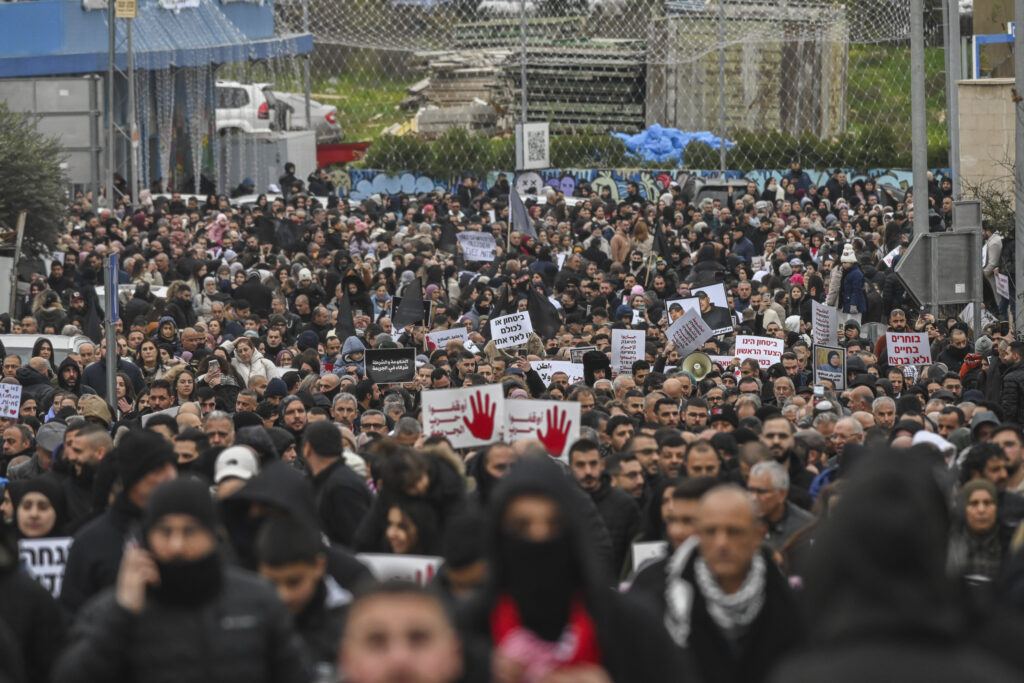
The current situation is admittedly very different: public opposition to permanent occupation and to the blanket destruction of southern Lebanon (destruction that is hardly taken notice of in Israel) is hardly visible at all, the more so as the political forces openly calling for the settlement and “Gazafication” of southern Lebanon today occupy important positions within the Israeli government. Moreover, in recent years, groupings like Uri Tzafon, which propagate a view of the Litani River as Israel’s “natural border”, have gotten an increasingly sympathetic reception in a society that now discusses military solutions to its political problems almost entirely to the exclusion of other approaches. Israeli society is further removed than ever from the kind of mass demonstrations against the government’s Lebanon policy that have taken place in the past — in 1982, for instance, an estimated 400,000 people demonstrated in Tel Aviv following the massacre at the Sabra and Shatila Palestinian refugee camp on the edge of Beirut.
The Dogma of Militarism
As Israel’s occupation of southern Lebanon and its territorial control over Syrian border regions have yet to develop deep historical roots comparable to the politics of occupation in the West Bank or the Gaza Strip, their future development remains an open question. Meanwhile, the political developments of recent weeks — particularly the erratic path of the US–Iran negotiations, and the resulting pressure on Israel to limit or cease its devastation of Lebanon — show that focusing on political ideology as a catalyst for Israeli policies of occupation and destruction can only be one of multiple factors needed to fathom the causes of this catastrophic situation.
At the same time, there is no reason to expect a change of policy for purely domestic political reasons, even if Benjamin Netanjahu loses the election this autumn; the dogma of militarism is currently too strong. As we saw in recent weeks, at present only international actors are able to force concessions from Israel — this was true of the agreement recently reached between Israel and Lebanon, by which Tel Aviv pledged not to pursue territorial claims in southern Lebanon, even while there remains no prospect of the Israeli army withdrawing from the region.
At the same time, we know that pacts brokered by the current US administration are often short-lived — and so this agreement, too, does not really spell an end to messianic plans for the settlement of south Lebanon.
It is therefore time for the German government and the EU to recognize the perilous nature of the current situation in southern Lebanon and along the Syrian border. They finally need to find clearer words than the contortions that make supposed Israeli “security interests” the starting point for expressions of “criticism” that cannot even be called half-hearted.
From a geopolitical perspective, the danger lies less in the historical Greater Israel project being applied unmodified to Syria and Lebanon. The danger, rather, is that military expansion will have created new facts on the ground, that then get consolidated ideologically by the messianic movement. There is now the risk that the intersection of Israeli security discourse and messianic activism will lead to illegal settlement in these regions as well. This can still be prevented.
Translated from German by Gegensatz Translation Collective
This article was first published in German in „nd.aktuell“ with the cooperation of the Rosa-Luxemburg-Stiftung.