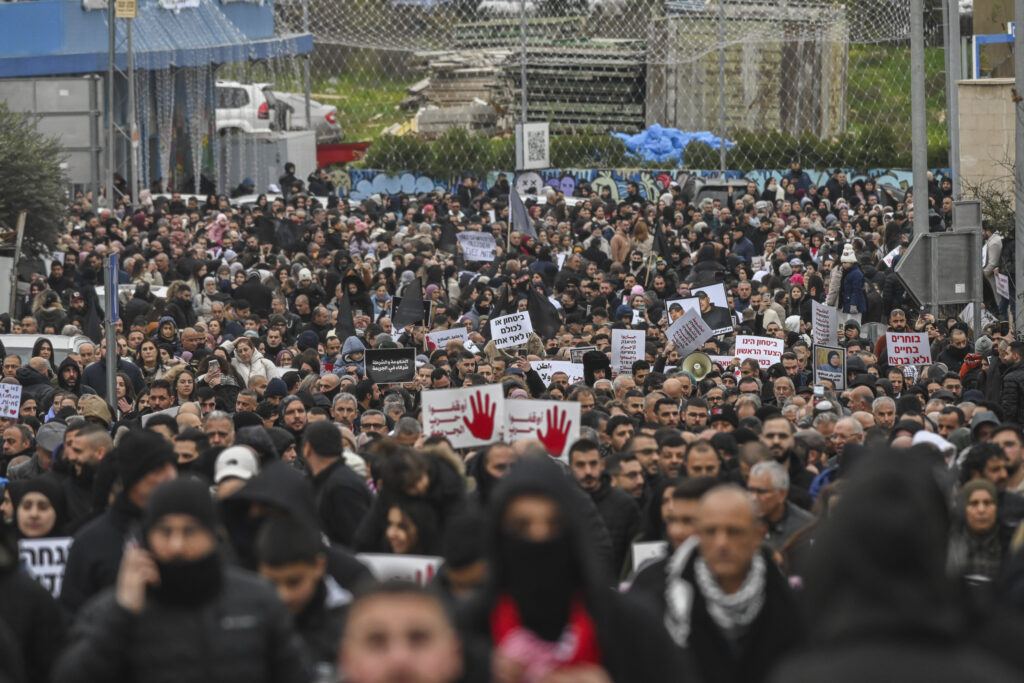
Israel, with the support of the United States and the West, has used the pretext of the October 7 attacks to prosecute a campaign of genocide, ethnic cleansing, and imperialist expansion for the past three years, reaching a record level of violence not seen since 1948. It has been relentlessly bombing and killing Palestinians, Lebanese, Iranians, and other civilians throughout the region, dispossessing or razing to the ground entire communities in Gaza, the West Bank, and Lebanon. The ongoing occupation since 1967, and the inability, or unwillingness of the International community to impose the establishment of a Palestinian state, have led the way for Israel’s messianic expansion and colonialist aspiration in Palestine and the region.
While general criticism of the government is widespread in the Jewish Israeli public, the majority of Israelis support the current aggressive militaristic policy and the ongoing dehumanization of Palestinians. A majority of Israelis also reject the Palestinian statehood, and would be happy to see ethnic cleansing in the land. This is the sad reality that we are facing.
But how does the concept of Zionism relate to these questions? Is the reality we are witnessing a natural and necessary outgrowth of the Zionist movement at large? Does the harshness of the current reality require us leftists to campaign as avowed antizionists? Or should we leave the question of Zionism to historians and theoreticians? Recent events in the German left have raised this question. As members of the socialist, Jewish-Arab, political movement in Israel – AlJabha/Hadash – we wish to offer our perspective on the matter, both on the analytical level and on the level of political language and mobilization.
We see Zionism as an ideology and praxis that is detrimental to the interests of both peoples living in Israel/Palestine.
First, we see Zionism as an ideology and praxis that is detrimental to the interests of both peoples living in Israel/Palestine. It is a form of bourgeois nationalism, which puts the interest of one people, the Jewish Israelis, over that of the Palestinians. This Jewish supremacist element, which was always present in Zionism, is now the official and blunt state ideology in Israel – we call this apartheid. Secondly, Zionism has a deep colonialist element: not only in its historical settler colonial form, but also in the ongoing colonization in the West Bank and Gaza. Thirdly, a Zionist worldview aligns with imperialist interests in the Middle East/West Asia – it has been so since the Balfour declaration to the current war of aggression in Iran. Finally, we see Zionism as an intrinsically militaristic ideology, which consistently prefers military solutions over negotiations. This too has intensified in recent years, with the utter rejection of diplomacy.
If our analysis rejects Zionism on so many levels, why then do we not put our antizionism at the forefront of political campaigning in Israel?
If our analysis rejects Zionism on so many levels, why then do we not put our antizionism at the forefront of political campaigning in Israel? It is because the term Zionism has become almost identical with any patriotic and national feeling among Jews. In Israel, Zionism has become synonymous with civic virtue. For many Jewish Israelis, Zionism is deeply connected to Jewish safety. It is an answer to decades of persecution of the Jews, and is an expression of the basic wish to be part of a collective. The Jewish-Israeli society, notwithstanding historical and current crimes, has the same rights as any other people, including self-determination. When we say we reject Zionism, for many Jewish Israelis, we reject their basic identity.
But isn’t this a defeatist position? If, in our deep analysis, we see Zionism as an instrument of dispossession, why do we give in to Israeli hegemonic interpretation of the term, which willfully ignores all of the inconvenient truths about Zionist history and present? The answer is that we do our politics to effect change in the world, not to feel better about ourselves. We do not think that the declarative and symbolic rejection of Zionism, at least in the Israeli context, is a helpful tool for persuasion. It rather creates alienation and risks pushing us further out of legitimate political argument. This is a terrible reality of rising fascism and a diminished space for dissent – but it is the Israeli reality.
Moreover, we have allies in Israel and around the world, who share the same fundamental political goals we strive for – self-determination for the Palestinian people, the end of the occupation, the establishment of an independent Palestinian state alongside Israel, and the rejection of all discrimination against Palestinians in Israel. Some of these allies consider themselves Zionist, because they subscribe to a minimalist understanding of zionism – self-determination for a Jewish collective in Israel. This right was recognized by the international community in the 1947 partition plan of Palestine, and was realized by the state of Israel itself.
We do not reject this right, yet as Friedrich Engels said: “A people which oppresses another cannot emancipate itself.”[1] Israel is still preventing the right of self-determination for Palestinians – the right for an independent palestinian state with real borders and an end to the suffering. We need to work together with those who believe in the rights of both peoples – and some of them are Zionists.
We also know that if and when a political solution is achieved, it will not be after Jewish Israelis reject Zionism, but when they decide that their collective and individual interests lie on the side of peace. We are materialists – we assert that Zionism, the ideology, will only be overcome after we begin to dismantle its material basis – that of apartheid and colonization.
Therefore, our focus must remain on practical actions against this reality – and not symbolic politics of denunciation. In the German case, this means advocating for concrete actions such as a ban on settlement products import, the suspension of the EU-Israel association agreement, and a complete ban on arms supply to Israel. These actions could challenge Zionism much more than the adoption of the antizionist label.
[1] „Ein Volk, das andere unterdrückt, kann sich nicht selbst emanzipieren”
This article was first published on May 7, 2026, in German in Neues Deutschland.